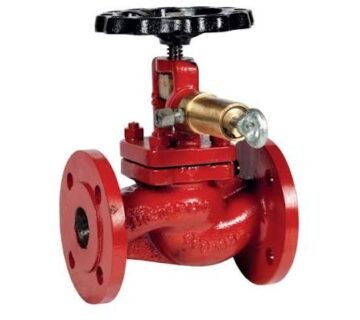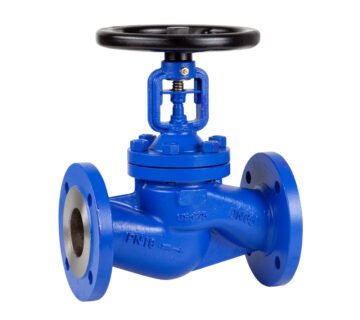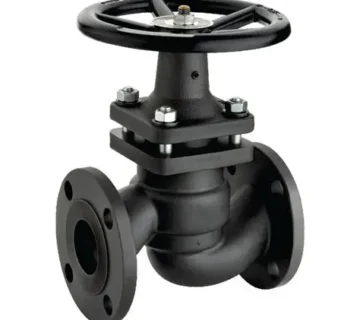

VectorFlow Valves Trading LLC supplies globe valves in Dubai, UAE — bronze globe valves, cast iron globe valves, and cast steel globe valves in JIS, DIN, and ANSI standard. Sizes 6mm to 350mm, flanged and screwed end connections. Globe valves are the correct choice wherever flow regulation rather than simple on-off isolation is required. Contact sales@vectorflowvalves.com or call +971 4 397 8524 for stock availability and pricing.
Globe Valves vs Gate Valves — The Practical Difference
This comparison comes up constantly in procurement, and it matters because the two valves are sometimes used interchangeably when they should not be.
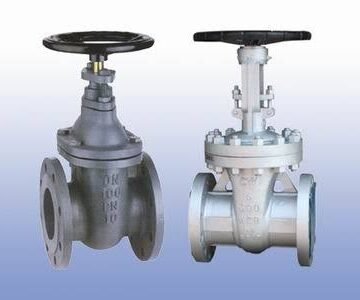
A gate valve is an isolation valve. The wedge gate slides across the full bore of the pipe — open means no obstruction, closed means the pipe is sealed. It does not regulate flow well. Partially open, the gate vibrates and the downstream face erodes rapidly. Gate valves are built to be either fully open or fully closed.
A globe valve is a regulating valve. The disc moves toward or away from a seat that is perpendicular to the flow. The gap between disc and seat controls how much fluid passes through. Partially open is a normal operating condition. Flow rate changes predictably with disc position, which makes globe valves the right tool for any application requiring consistent flow control rather than simple shutoff.
The trade-off is pressure drop. The internal flow path in a globe valve changes direction twice — up over the seat and back down — creating more resistance than the straight-through path of a fully open gate valve. In large-diameter lines where pressure drop is a design constraint, this matters. In most marine and industrial control applications, it does not.
Materials and Standards at VectorFlow Dubai
Bronze Globe Valves
JIS 5K and 10K in screwed and flanged end. Sizes 6mm to 100mm. The standard material for marine seawater service, potable water, and low-pressure steam in small bore sizes. Aboard vessels, bronze globe valves regulate cooling water flow, control steam to heating coils, and isolate instrument connections. Resistant to the corrosion that attacks cast iron in salt water environments.
Cast Iron Globe Valves
DIN PN16 and JIS 5K in flanged end. Sizes 15mm to 300mm. Used in industrial plant utility systems, freshwater cooling circuits, compressed air, and building services where seawater corrosion is not a concern. Cast iron handles moderate pressures at ambient to moderate temperatures competently. For temperatures above 120 degrees C or pressures above PN16, specify cast steel.
Cast Steel Globe Valves
ANSI Class 150LB to 900LB, DIN PN16 to PN40, JIS 20K. Sizes 15mm to 350mm. The correct specification for oil and gas process service, high-pressure steam, and any application where cast iron fails on safety grounds. ASTM A216 WCB is the standard grade for ambient to moderate temperature service. A217 WC6 for elevated temperature service in power generation and petrochemical applications.
Applications Where Globe Valves Are the Right Answer
Cooling Water Regulation
Marine engine cooling systems, industrial heat exchangers, and data centre cooling all require variable flow control to maintain temperature. A globe valve at the heat exchanger inlet or outlet adjusts cooling water flow in response to temperature without the seat erosion that would result from throttling a gate valve.
Steam Control
Steam tracing lines, steam to heat exchangers, and steam supply to process users all need regulation. Globe valves handle the combination of high temperature, high pressure, and throttling duty that steam service imposes. Bronze in small bore for low-pressure steam. Cast steel for high-pressure steam in power plants and process facilities.
Boiler Feed and Bypass Lines
Boiler feedwater control valves are globe valves. The ability to regulate flow precisely at varying pressures makes them suitable for maintaining boiler drum level. Bypass valves around control valves for commissioning and emergency manual control are also globe valves.
Oil and Gas Injection Lines
Chemical injection for corrosion inhibition, scale prevention, and hydrate suppression in gas lines uses globe valves at the injection point. The low flow rates and need for precise dosing are exactly what globe valves are designed for.
Instrument Root Valves
Small-bore globe valves in screwed end serve as root valves on pressure gauge and transmitter tapping points. They isolate instruments for maintenance without shutting down the line. Bronze in 8mm to 25mm for most instrument service.
Recognising When You Have the Wrong Valve
A common maintenance problem in UAE industrial plants and vessels is premature valve failure caused by using a gate valve where a globe valve should have been installed. The signs are a gate valve that leaks by when closed, a rising stem that is damaged or bent, or a valve that cannot be operated smoothly. These all point to throttling service on a valve that was not designed for it.
The replacement should be a globe valve sized for the same line and rated for the same pressure class. The body size may be one nominal size smaller than the gate valve because globe valves have a smaller face-to-face dimension for the same bore — check the dimension before ordering.

Frequently Asked Questions
Q: What is globe valve coefficient of flow (Cv)?
The Cv value describes how much water in gallons per minute passes through a valve at a one psi pressure drop when fully open. It is used to size valves correctly for the required flow rate. A globe valve with a Cv too small for the application causes excessive pressure drop. Too large and the control range at partial opening becomes difficult to manage. The manufacturer datasheet provides Cv values for each valve size.
Q: Can globe valves be installed in any orientation?
Globe valves can be installed horizontally or vertically with flow upward through the seat. Vertical installation with flow downward through the seat is not recommended for most designs because the disc weight assists closing and makes the valve harder to open under pressure. Check the manufacturer recommendation for the specific valve design.
Q: What is the difference between a lift-type and a needle valve?
A needle valve is a type of globe valve where the disc is replaced by a needle-shaped stem that provides very fine flow control at very low flow rates. Standard globe valves handle moderate to high flows. Needle valves are used for instrument calibration, sample system control, and any application requiring precision at low flow.
Q: How often should globe valve packing be replaced?
Packing life depends on service conditions. In clean water service at moderate temperature and pressure, packing may last several years. In steam service or where the stem cycles frequently, annual inspection is reasonable. If a valve starts to leak around the stem packing gland, the packing can usually be replaced in service by tightening the gland nut or adding packing rings without removing the valve from the line.
Q: Do you supply globe valves for cryogenic service?
Cryogenic globe valves for LNG service require extended bonnet design and special seat materials rated to minus 196 degrees C. VectorFlow can source these on inquiry with the appropriate specification. Standard cast iron and bronze globe valves are not suitable for cryogenic temperatures.
Contact: sales@vectorflowvalves.com | +971 4 397 8524 | Ras Al Khor Industrial Area 2, Dubai, UAE