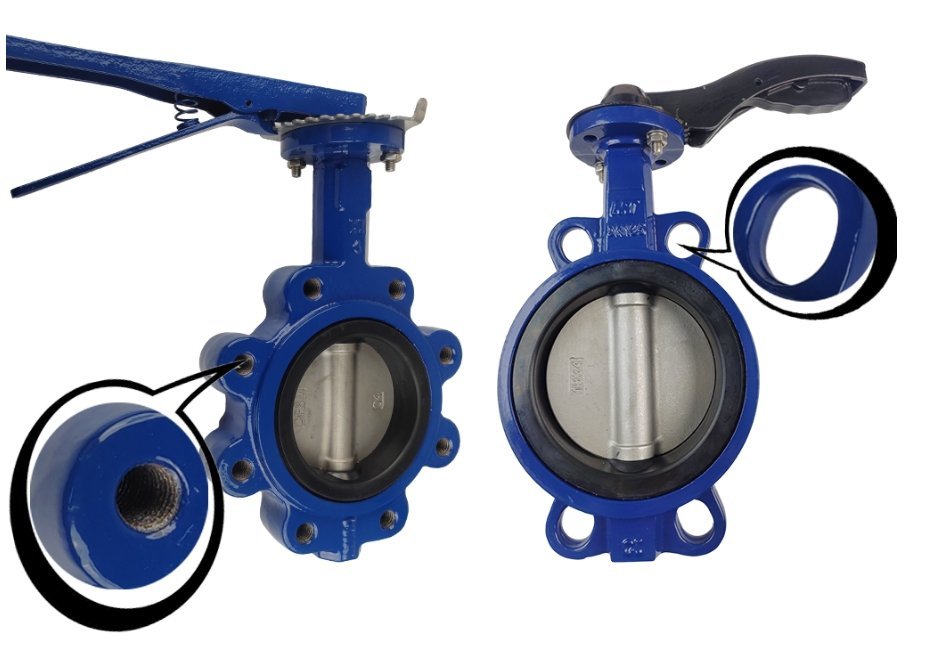
Every butterfly valve works the same way inside: a disc on a shaft turns a quarter turn to open or close the pipe. What changes from one butterfly valve to the next is the body: wafer, lug, semi-lug or double flanged. The body decides two practical things. How the valve bolts into the line, and what happens when you unbolt the pipe on one side.
Wafer bodies are the lightest and cheapest but can’t be used at the end of a line. Lug bodies can hold pressure with one side of the pipe removed. Double flanged bodies bolt in like a gate valve and suit large sizes and mains. Semi-lug sits between wafer and lug, and “centre handle” isn’t a body type at all. The table gives the overview, and the sections below explain each one.
| Body type | How it bolts in | End-of-line (dead-end) service | Where it’s used most |
| Wafer | Clamped between two flanges by long bolts or studs that pass outside the body | No | Continuous water, HVAC and utility lines |
| Lug | Threaded lugs on the body take each flange’s bolts separately | Yes, often at a lower pressure rating set by the manufacturer | Lines where one side may be removed while the other stays live |
| Semi-lug | Wafer-style body with a few lugs that help locate it | Treat as no, unless the manufacturer rates it | Common in Japanese-standard marine valves |
| Double flanged | Integral flanges on both ends, bolted like any flanged valve | Yes | Large diameters, pump stations, water and seawater mains |
Wafer: the default for continuous lines
A wafer valve has no flanges and no threaded holes. It sits between the two pipe flanges, and long bolts or studs pass from one flange to the other, outside the valve body, squeezing it in place. The body is short and light, which is why wafer valves are the cheapest way to put a quarter-turn valve in a line.
The catch is that the same bolts hold both flanges. Take the downstream flange off and nothing holds the valve against the upstream pressure. That’s why a wafer valve shouldn’t go at the end of a line, or anywhere you plan to remove the pipe on one side while the other stays live.
Two installation points matter. The valve has to be centred so the disc doesn’t touch the flange or pipe bore as it opens. And the disc swings out past the body faces when it’s open, so check it clears whatever is bolted next to it, such as a lined pipe, a reducer, a check valve or a strainer.
Lug: when you need to work on one side
A lug valve has threaded lugs cast around the body that line up with the flange bolt holes. Each pipe flange bolts into the lugs with its own shorter bolts. Remove one flange and the other stays bolted, with the valve still holding the line closed.
That’s the reason to pay more for a lug body: maintenance access. Pump suctions and discharges, equipment you’ll need to isolate and lift out, and branches that will be extended later are all good candidates.
One thing to check before you rely on it. Many manufacturers give lug valves a lower pressure rating for dead-end service than for in-line service. Ask for the dead-end rating as well as the body rating.
Semi-lug: a wafer with a little help
A semi-lug body is mostly a wafer with a small number of lugs added, which help line the valve up during installation. You’ll see semi-lug bodies often in Japanese-standard marine butterfly valves. Unless the manufacturer specifically rates a semi-lug valve for dead-end service, treat it like a wafer.
Double flanged: for big pipes and mains
A double flanged butterfly valve has full flanges cast on both ends and bolts in like a gate valve, with its own bolts at each flange. It’s heavier and costs more than a wafer or lug valve of the same size. In return it’s rigid, straightforward to install on large pipes and can be used for dead-end service.
You’ll find it on large water and seawater mains, at pump stations and on intakes. Marine versions exist too. One example on the market is a short double flanged body with face-to-face dimensions to JIS F 7480, the Japanese marine butterfly valve standard, drilled for JIS 5K and 10K flanges.
Centre handle: an operator, not a body
“Centre handle” turns up on quotations for marine butterfly valves and confuses buyers looking for a body type. It describes the manual operator, which some Japanese makers list as a “center handle (vertical)” actuator. They offer it on both wafer and semi-lug bodies, so a quotation can read “wafer, centre handle” and both words matter. One is the body. The other is how you turn it.
The flange standard matters as much as the body
A wafer or lug valve has to match the bolt circle of the flanges it sits between, and JIS, DIN and ASME flanges are drilled differently. A JIS 10K flange, a DIN PN16 flange and an ASME Class 150 flange of the same nominal size generally don’t share a bolt pattern. Lug valves are the least forgiving, because their threaded holes are fixed.
JIS 5K and 10K flanges are common on ships built in Japan, Korea and China. European-designed plants tend to use DIN and EN PN ratings, and American-pattern systems use ASME classes. When you order a replacement, the flange standard and pressure class matter as much as the body type. Our pages on JIS standard valves and DIN standard valves go into those standards in more detail.
One marine position with its own rule
Among marine valves, one position has specific SOLAS wording: a pipe through the collision bulkhead. Regulation II-1/12 normally calls for a screw-down valve there. Amendments in force since 1 January 2020 allow cargo ships to fit a butterfly valve instead, provided it’s suitably supported by a seat or flanges and can be operated from above the freeboard deck. The same regulation requires those valves to be steel, bronze or another approved ductile material and rules out ordinary cast iron. Confirm with class which body type and material they’ll accept in that position before you order.
Seats and materials in brief
Bodies come in cast iron, ductile iron, carbon steel and stainless steel. Discs are often stainless. Japanese listings use SCS13 and SCS14, the JIS cast equivalents of 304 and 316 stainless. The seat is usually the part that limits the service:
- EPDM is the usual choice for water, including chilled and treated water. It isn’t suitable for oils and fuels.
- NBR handles oils and fuels and is widely used in marine butterfly valves.
- For seawater, choose body and disc materials with corrosion in mind. Aluminium bronze bodies are one option some marine makers offer.
For more on body materials, see our comparison of cast iron, ductile iron and cast steel valves.
Choosing in four questions
- Will you ever need to remove the pipe on one side while the other side stays under pressure? Choose lug or double flanged, and check the dead-end rating.
- Is the pipe large, or is the valve going into a main where rigidity matters? Choose double flanged.
- Is it a continuous run where the valve stays sandwiched for its whole life? A wafer is fine and costs least. Semi-lug makes alignment easier and is common in marine JIS systems.
- Is it on a ship, in a position with its own rule such as the collision bulkhead? Check with class before choosing the body and material.
Butterfly valves at VectorFlow
VectorFlow supplies butterfly valves from 1.5″ to 24″ with cast iron, ductile iron, carbon steel and SS304 or SS316 bodies, to JIS, DIN and ASME standards. Body types include wafer, lug, semi-lug and double flanged, and centre handle operators are available. Pneumatic, hydraulic and electric actuation can be added for remote or automated operation. Contact the team with the size, flange standard, pressure class and medium, and they can match the body and seat.
Phone: +971 4 397 8524 | Email: enquiries@vectorflowvalves.com | VectorFlow Valves Trading LLC, Ras Al Khor Industrial Area 2, Dubai, UAE
Frequently asked questions
Can a wafer butterfly valve be used at the end of a line?
No. A wafer valve is held in place by bolts running between the two pipe flanges. Remove the downstream flange and nothing holds the valve. Use a lug or double flanged valve rated for dead-end service.
Is a lug butterfly valve stronger than a wafer valve?
Not in the sense of a higher pressure rating. The difference is how it’s bolted in. A lug valve can stay in service with one side unbolted, and a wafer valve can’t.
Can I swap a wafer valve for a lug valve without changing the pipework?
Often, because many designs use the same face-to-face length for wafer and lug bodies. Confirm the dimension on the datasheet, check the lug threads match your flange drilling, and use the right bolt length on each side.
Which butterfly valve type is used on ships?
Wafer and semi-lug bodies to JIS F 7480 are common in Japanese-standard marine systems, and double flanged bodies appear in larger sizes. The position matters too. The collision bulkhead and ship-side connections have material and arrangement rules that class will check.